
Introduction
The Hyper-Speed Future of Shopping Is Already Here
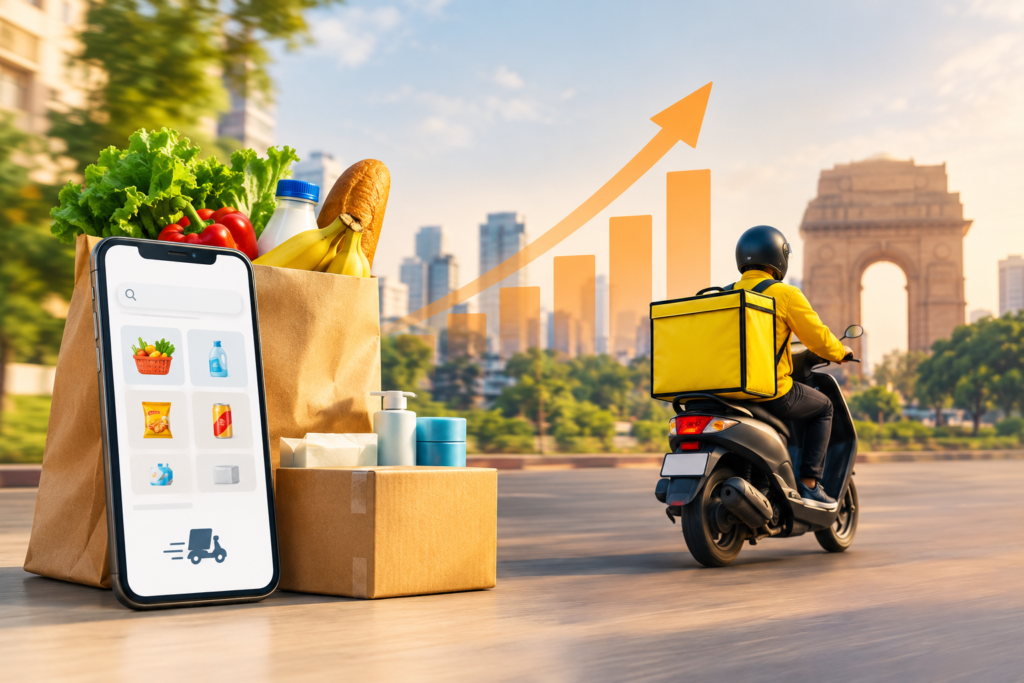
In the race against time, India’s retail industry is seeing a new frontrunner emerge: Quick Commerce (Q-commerce). With the promise of delivering essentials in just 10–30 minutes, Q-commerce is redefining convenience and reshaping consumer expectations. From groceries to personal care and even electronics, India’s urban and semi-urban population is embracing this shift wholeheartedly.
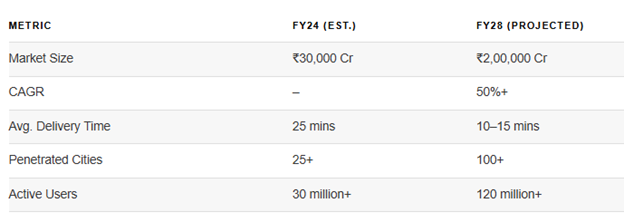
According to industry estimates, India’s quick commerce market is set to skyrocket from around ₹30,000 crore in FY24 to a staggering ₹2 lakh crore by FY28, registering a CAGR of over 50%. That’s not just growth—that’s a retail revolution in fast-forward mode.
What Is Quick Commerce?
Quick commerce refers to ultra-fast delivery services that aim to fulfill customer orders—typically daily-use items—within 10 to 30 minutes. It leverages dark stores, micro-warehouses, and location intelligence to ensure fast fulfillment from the nearest hub.
Unlike traditional e-commerce (which focuses on scheduled deliveries), Q-commerce is built for instant gratification—think of it as the digital avatar of your neighborhood kirana, only much faster and tech-enabled.
Why Is Q-Commerce Booming in India?
- Time-Starved Urban Population
With hectic work schedules, traffic congestion, and rising aspirations, Indian consumers—especially Gen Z and Millennials—are prioritizing convenience over price. Quick commerce addresses this perfectly. - Mobile-First Economy
Over 700 million smartphone users and widespread access to digital payments make it easier than ever to browse, order, and receive products within minutes. - Changing Lifestyle & Household Needs
Consumers are making smaller, more frequent purchases instead of monthly bulk buying. Q-commerce allows spontaneous, need-based buying—like ordering ice cream during a movie night or shampoo right before a trip. - Heavy Investments & Consolidations
Players like Blinkit (Zomato), Zepto, Swiggy Instamart, and Big Basket Now have raised substantial capital and are aggressively expanding dark stores, tech capabilities, and service zones.
Market Snapshot: FY24 vs FY28 (Projected)
What’s in the Cart? Most Ordered Items via Q-Commerce
- Fresh Fruits & Vegetables
- Dairy & Beverages
- Packaged Food & Snacks
- Personal Care & Hygiene
- Medicines & Baby Products
- Home essentials and even fashion basics
Who’s Winning the Q-Commerce Game?
- Zepto—India’s first unicorn in quick commerce, known for its 10-minute delivery promise and strong backend tech.
- Blinkit (Zomato)—Rapid expansion through dark stores and innovative SKUs.
- Swiggy Instamart—Strong presence through bundled value packs and loyalty programs.
- Big Basket Now—Leveraging the Tata Ecosystem for Competitive Reach.
- Reliance JioMart Express—backed by Kirana digitization and massive retail muscle.
Challenges on the Road
Despite the boom, the Q-commerce sector is not without hurdles:
- Unit Economics: Delivering in 10 minutes means higher logistics and manpower costs.
- Inventory Management: Keeping dark stores stocked with fast-moving SKUs is a constant challenge.
- Profitability Pressure: Companies are burning capital for customer acquisition and operational scale.
- Regulatory Scrutiny: Rising concerns about delivery rider safety, labor laws, and urban traffic impact.
The Road Ahead: What to Expect by FY28
- Tier-II & III City Expansion: As digital penetration deepens; demand will spread beyond metros.
- AI-Driven Fulfillment: Predictive analytics and AI will optimize product stocking and route planning.
- Voice & Chat Commerce: Ordering via voice assistants and chatbots will gain momentum.
- Sustainability Shift: Eco-friendly packaging and electric delivery fleets will take center stage.
Conclusion
India’s quick commerce market is no longer just a pandemic-era experiment—it’s an integral part of modern retail. With the right mix of technology, local insights, and customer obsession, Q-commerce is setting the tone for the next-gen shopping experience.
As we race towards ₹2 lakh crore by FY28, one thing is clear: In India, speed isn’t just a service feature anymore—it’s a consumer expectation.